
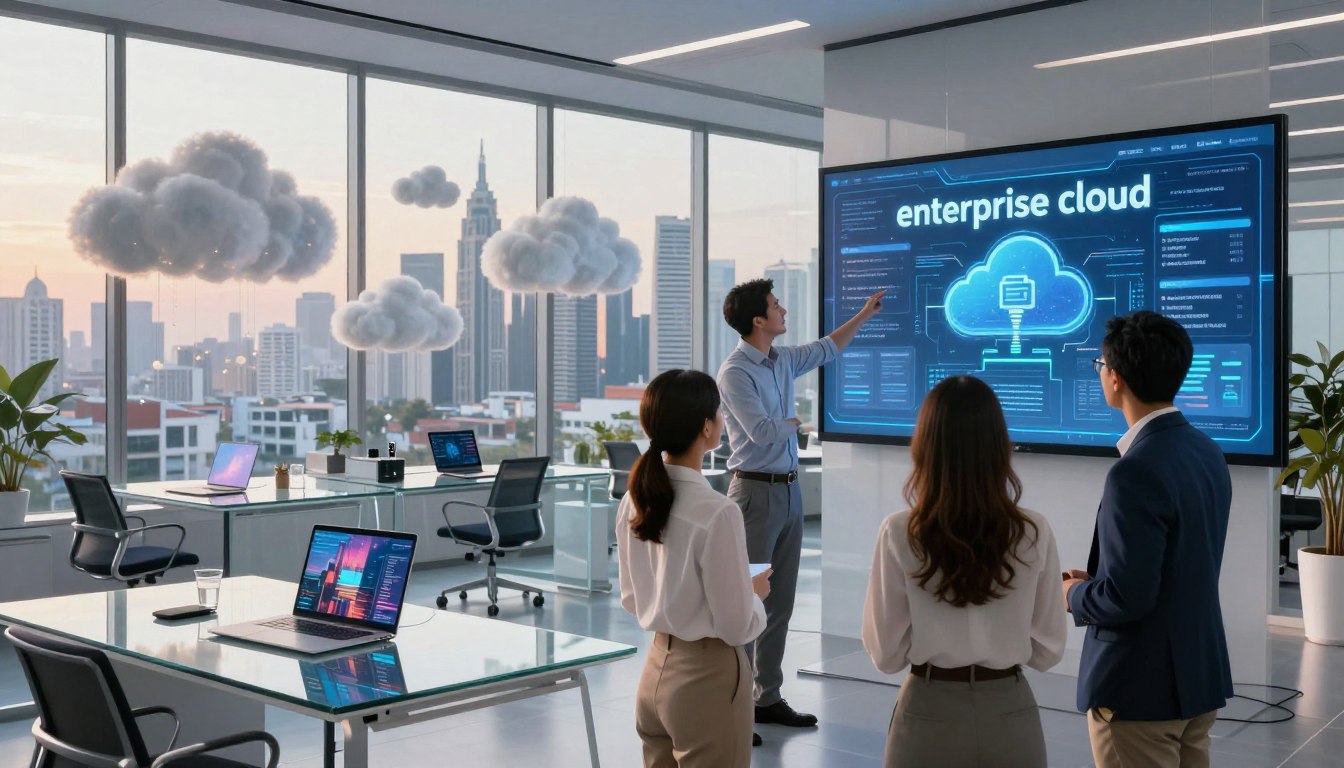
Subscription fatigue and runaway egress fees are forcing Philippine businesses to rethink the rent-based cloud model. We see that model failing modern firms—costs rise and control slips away.
We are ReadySpace — sovereign infrastructure experts helping organizations regain custody of their systems and data. Our focus is a high-performance private alternative based on Proxmox that delivers predictable costs, stronger control, and local performance for critical applications.
Moving away from proprietary platforms lets companies modernize IT without sacrificing security or scalability. We provide a clear migration path, technical tooling, and managed services so teams can lift workloads, retain access to storage and analytics, and cut dependence on expensive hardware.
For Philippine decision-makers seeking a robust enterprise cloud strategy, learn how we help you take back control and build a resilient infrastructure — see our business systems offerings at ReadySpace business systems.
Key Takeaways
- Rent-based models increase costs and reduce control for Philippine businesses.
- We offer a Proxmox-based private platform for performance and sovereignty.
- Our migration path moves critical data and applications with minimal disruption.
- Local infrastructure improves access, storage performance, and analytics.
- ReadySpace combines expert services and management to secure long-term scalability.
The Shift Toward Open Source Enterprise Cloud
Local businesses are choosing open-source infrastructure for better uptime and clearer cost models. We see a move toward open standards that combine high availability with predictable management.
Uptime guarantees now commonly exceed 99.99%, keeping mission-critical applications and data available for Philippine organizations. The modern enterprise cloud delivers IaaS, PaaS, and SaaS tiers so teams can run workloads with enterprise-grade reliability.
We provision resources on demand and support a hybrid model that pairs public cloud access with private cloud protection. This approach gives you flexibility, control, and better storage performance for analytics and applications.
- Open standards speed deployment and reduce vendor lock-in.
- Security is embedded at every layer—firewalls, encryption, and automated backups.
- Disaster recovery and failover are built into operations to limit downtime.
| Feature | Benefit | Typical SLA |
|---|---|---|
| Open standards | Faster innovation, lower lock-in | — |
| Hybrid deployment | Balance of access and security | 99.99%+ |
| On-demand resources | Cost predictability and scalability | Variable |
To explore a practical migration path, see our virtual data center offering for Philippine organizations.
Breaking Free from VMware Subscription Fatigue
Rising license bills for proprietary hypervisors are forcing many Filipino firms to rethink their infrastructure choices.
The Cost of Proprietary Lock-in
Subscription fatigue shows up as steady fee increases and surprise renewals that erode project budgets. Many businesses find their growth blocked by licensing models tied to specific hardware and vendors.
We audit systems to uncover where proprietary software and hardware drive up operating costs. That gives leaders a clear view of wasted spend and lock-in risk.
Transitioning to Open Standards
We guide teams toward open standards and alternatives — from Nutanix AHV to open-source hypervisors — so you keep high-performance computing without punitive fees.
- Move workloads with minimal downtime.
- Retain ownership of data, storage, and architecture.
- Choose public, private, or hybrid cloud models that fit your needs.
“We help organizations simplify security and access management by removing vendor constraints and restoring operational flexibility.”
| Factor | Proprietary Hypervisor | Open-Standards Alternative |
|---|---|---|
| Licensing | Recurring, rising fees | Predictable or one-time costs |
| Control | Vendor-dependent | Full ownership of stack |
| Migration | Complex, costly | Tooling and managed services available |
ReadySpace supports audits and migrations, and we offer managed options — see our cloud-managed servers for Philippine organizations.
Eliminating Hidden Cloud Egress Fees
Unexpected data-transfer bills can turn a planned migration into a budget crisis for Philippine firms.
Hidden egress fees often catch businesses off guard and raise the total cost of ownership for an enterprise cloud deployment. We build pricing models that are transparent—so you forecast IT budgets with confidence.
Unlike many public cloud providers that charge for data movement, our approach removes surprise charges. We optimize data layout and storage to cut transfer volumes and keep operational costs predictable.
- Offer flat, predictable billing for core services and platform management.
- Manage private and hybrid cloud resources to reduce cross-site transfers.
- Embed security and data management so protection never conflicts with cost savings.
Organizations that partner with us avoid the vendor tax imposed by some cloud providers. The result: scalable computing and reliable access without hidden fees.
Sovereign AI Infrastructure for Philippine Growth
Philippine firms need AI infrastructure that keeps sensitive data local while unlocking faster analytics. We build platforms that respect local laws and give teams direct control over resources.
Data Sovereignty in the Philippines
We ensure sensitive data stays within the Philippines so compliance is simpler and risk is lower. That local custody improves latency for applications and analytics.
Scaling from Five to Eight Figures
Our solutions are designed to scale with your business. We provide the compute and storage needed to grow revenue from five to eight figures without surprise costs.
AI-Ready Infrastructure
We embed machine learning platforms directly into your private platform so teams can train models and run real-time analytics.
- Predictable control and security for regulated organizations.
- Rapid deployment of AI technologies and compute resources.
- Actionable insights from local data to speed decision-making.
Partnering with us lets you focus on core business goals while we manage the underlying cloud infrastructure for your AI initiatives.
Managed Services Versus DIY Infrastructure Comparison
Choosing who runs your infrastructure — your staff or an external team — changes costs, risk, and speed to market. This decision affects daily operations, long-term budgets, and how fast you deploy applications.
Managed services let your IT team focus on core projects instead of maintaining physical servers. We provide a management layer that handles security, updates, and resource allocation so applications stay fast and secure.
By contrast, a DIY approach gives control but often adds hidden costs and operational complexity. In-house teams spend time on routine tasks, incident response, and patching — work that slows business innovation.
We act as an extension of your IT department, offering proactive monitoring, faster incident response, and specialist skills for hybrid setups that mix public cloud and private cloud resources.
| Factor | Managed Services | DIY Infrastructure |
|---|---|---|
| Operational overhead | Low — vendor handles routine ops | High — staff run daily tasks |
| Predictable costs | Yes — clear service fees | No — hidden upgrades and labor |
| Security & compliance | Managed policies and monitoring | Depends on in‑house expertise |
| Speed to value | Fast — ready platform and support | Slower — build and tune internally |
For Philippine organizations weighing options, managed services often deliver better uptime, clearer pricing, and stronger security for business data and computing workloads. Learn more about our cloud-based server solutions to see which model fits your needs.
Core Components of a Scalable Architecture
Right‑sized compute and tiered storage are the backbone of any scalable architecture. We design systems so virtual machines handle application load without wasted capacity.
Cloud storage services let businesses keep vast amounts of data secure and accessible. We map workloads to storage tiers — fast blocks for databases, cost‑efficient object stores for archives.
Compute and Storage Optimization
We use advanced virtualization and container platforms to give teams flexibility and speed. That setup reduces latency for analytics and keeps resource use efficient.
- Seamless integration of compute, storage, and networking for high‑performance applications.
- Optimized tiers prevent overspending on unused hardware capacity.
- Security and disaster recovery are applied across all components for business continuity.
- Hybrid and public private approaches give a unified management plane for easy orchestration.
- Support for containerized applications speeds innovation and real‑time response.
For practical design patterns, see our guide on scalable architecture to align infrastructure with business goals in the Philippines.
Strategic Action Plan for AI Citation and Migration
A focused migration plan turns AI ambitions into steady, measurable value for Philippine teams. We outline clear steps so your move to an enterprise cloud is pragmatic, secure, and tied to business outcomes.
Core action items
- Conduct a comprehensive audit of your IT landscape to spot workloads ready for migration.
- Define clear business objectives and KPIs — cost reduction, latency, or time-to-market.
- Establish governance to enforce security, compliance, and resource policies across the platform.
- Implement a phased migration — start with non-critical apps before moving mission-critical AI workloads.
- Train internal teams on cloud-native tools and management to sustain operations post-migration.
- Partner with us at sample AI agents to leverage sovereign AI expertise and tailored solutions.
- Continuously monitor performance and costs; iterate to optimize value and efficiency.
We support organizations through each step — from audit to steady-state operations — so AI delivers real returns without surprise risk.
Overcoming Common Enterprise Cloud Challenges
Secure integration — not rip-and-replace — is the pragmatic route for many Philippine organizations. We focus on protecting sensitive data while keeping legacy applications available during migration.
Security and Compliance
Moving sensitive data increases exposure to threats, so we require strong identity controls and end-to-end encryption. Our policies map to local and international rules to keep your operations compliant.
We deploy platform firewalls, network encryption, and continuous monitoring to reduce risk and speed incident response. These measures tie directly into disaster recovery plans so data restores quickly after an event.
Legacy System Integration
Older systems often create silos and slow performance. We bridge them with APIs, gateways, and secure migration tooling that preserve business continuity.
- Reduce vendor lock-in by designing a portable architecture across cloud platforms and providers.
- Cut surprise costs through proactive monitoring and transparent billing.
- Use phased moves to protect applications and hardware during transition.
Organizations that partner with us gain hands-on guidance and managed options — see our cloud server support for practical assistance during migration.
Conclusion
Reclaiming your technology stack starts with choices that favor openness, transparency, and local performance.
Transitioning to an open-source approach helps Philippine firms scale, protect data sovereignty, and cut costs tied to vendor lock-in and hidden egress fees.
Our sovereign AI infrastructure gives you a secure, high-performance foundation for growth. We combine expert migration plans and managed services to resolve security, compliance, and legacy integration issues quickly.
ReadySpace is your partner in building a resilient, future-proof digital backbone.
Stop renting your infrastructure. Apply for a 30-minute Infrastructure Discovery Session with ReadySpace Philippines at https://readyspace.com.ph.
FAQ
Why are Philippine enterprises moving to open source cloud solutions?
We see more businesses adopt open source platforms to reduce vendor lock-in, cut licensing costs, and gain flexibility. Open standards let teams integrate tools, run workloads across public and private environments, and optimize infrastructure for local compliance and performance.
What drives the broader shift toward open source enterprise cloud?
The shift is driven by cost control, innovation speed, and platform portability. Open source ecosystems enable faster feature development, community-driven security fixes, and better alignment with hybrid deployment models that businesses prefer.
How significant is VMware subscription fatigue for local firms?
Many organizations report rising license fees and unpredictable renewals. That fatigue pushes them to evaluate open standards and alternative platforms that offer transparent pricing and easier migration paths.
What are the real costs of proprietary lock-in?
Proprietary lock-in often leads to higher long-term spend, limited choice of tools, and slower response to new demands. It can also complicate disaster recovery and multi-provider strategies that businesses need for resilience.
How do organizations transition from proprietary stacks to open standards?
Successful transitions combine phased migration, refactoring of critical apps, and strong governance. We recommend pilot projects, containerization, and partnering with managed services to reduce risk and maintain operations.
How can businesses eliminate hidden egress fees?
Reducing egress costs starts with architecture that minimizes cross-provider data transfers, using local ingress/egress points, and negotiating clear terms with providers. Open platforms also let teams move data freely between sites.
What does sovereign AI infrastructure mean for Philippine growth?
Sovereign AI infrastructure ensures data stays within national boundaries and complies with local rules. It also supports local innovation by providing low-latency access to models and analytics for developers and enterprises.
How do we address data sovereignty requirements in the Philippines?
We implement regional data residency controls, encrypt data at rest and in transit, and use audited providers with local presence. Transparent policies and regular compliance checks keep organizations aligned with regulations.
How do companies scale AI initiatives from five to eight figures?
Scaling requires solid infrastructure, model lifecycle management, and cost forecasting. We focus on right-sized compute, efficient storage tiers, and automation for training and deployment to keep spend predictable while growing impact.
What makes infrastructure "AI-ready"?
AI-ready infrastructure offers GPU or accelerator support, fast storage, high-throughput networking, and orchestration tools for distributed training. It also integrates monitoring and MLOps pipelines for repeatable production workflows.
When should organizations choose managed services over DIY infrastructure?
Choose managed services when teams need faster time-to-value, predictable operations, and expert support for security and compliance. DIY suits firms with deep in-house ops skills and tight control requirements. Hybrid approaches often balance both.
What are the core components of a scalable architecture?
A scalable architecture combines compute that scales horizontally, optimized storage tiers, orchestration layers for workloads, and observability tools. Together they ensure performance, cost efficiency, and operational agility.
How do we optimize compute and storage for scale?
We match workload profiles to instance types, use autoscaling, and apply lifecycle policies for storage. Using object storage for archive, block for performance, and tiered caching reduces cost while maintaining access.
What is a practical action plan for AI migration and adoption?
Start with assessment and prioritization, run proof-of-concepts, prepare data pipelines, and establish governance. Then move to phased production deployments with clear rollback plans and continuous monitoring.
How do organizations overcome common cloud challenges like security and compliance?
Address challenges with strong identity controls, encryption, regular audits, and automated policy enforcement. Combining local expertise with platform capabilities ensures compliance and reduces risk.
How can legacy systems be integrated into modern architectures?
We use APIs, containerization, and middleware to wrap legacy functions. Incremental refactoring and strangler patterns help migrate workloads without disrupting business operations.

Comments are closed.